Exploring Raja Ampat: A Paradise Above and Below the Water

Updated: Mar 1
Raja Ampat
Far, far away lies a place that seems to know only nature. No wars, no violence, no hatred — just acceptance, love, simplicity, and the wild beauty of the natural world. This is Raja Ampat, the last paradise, a heaven both above and beneath the water.
Nestled in West Papua, Indonesia, Raja Ampat means “the four kings,” named for the four main islands — Waigeo, Misool, Salawati, and Batanta — surrounded by roughly 1,500 smaller islands.
Arriving in Raja Ampat
Planning the trip might feel complicated, but it’s actually pretty straightforward. We flew from Belgium to Jakarta, spending one night there to recover from the long journey. Jakarta is big, chaotic, and not the kind of place you want to linger, so we stayed somewhere simple, clean, and comfortable — perfect for a 24-hour travel marathon. It was called Sambina Prime hotel(18€ per night)
That day, we wandered Chinatown, which was fun but nothing mind-blowing. If you still have energy, you could continue straight to Sorong, but we preferred to split the journey to keep our sanity intact.
Getting around Jakarta was a breeze thanks to the Grab app — taxis and motorbike taxis are convenient and cheap. For me, it was a relief compared to my last Asia trip, when a street taxi driver swiped my bag. Lesson learned: always know your driver.(which was yet not possible back in 2013 aka ‘god bless technology’).
From Jakarta, we flew to Sorong, and from there, it was smart to continue directly to Raja Ampat. Sorong itself isn’t the most exciting place, and the quicker you leave, the sooner you reach paradise.
To get from Sorong to Waisai, you take the Bahari Express ferry, which departs twice daily at 9:00 and 14:00 and takes about 2.5 hours. Tickets cost IDR 125,000 (~7€) for economy, or IDR 250,000 (~15€) for VIP. We opted for economy — a bit hot and busy, but authentic and honestly, it makes arriving in paradise feel even sweeter. You can also head to the deck, feel the breeze, and watch the views — your first glimpse of heaven on Earth.

You have installed. Waisai.
Finally, we arrived in Waisai, the bustling little hub that serves as the gateway to Raja Ampat’s smaller islands. To continue onward, there are two official government fees you need to pay:
Raja Ampat Marine Park Entry Pe — 700,000 IDR-(35€) at the Waisai Harbour Homestay Information Center.
Raja Ampat Visit— 300,000- (15€) IDR, at the Raja Ampat Regency Tourist
That’s it — these are the only official fees you’ll be asked for while visiting Raja Ampat.
From there, it’s all about boats. Usually, your next homestay will pick you up, and while the ride can be a bit pricey (fuel is expensive here!), you can split the cost between four people. The best approach is to contact your homestay a day in advance to confirm pickup.
Homestays in Raja Ampat
Raja Ampat is full of homestays — lots, lots of them. Despite the name, a homestay isn’t exactly staying with a local family… but it’s kind of close. Think of it as all-inclusive simplicity: small shacks with beds, shared bathrooms (some upgrade to private bathrooms for a little extra), and meals included. We stayed in homestays ranging from basic to luxury-basic, and honestly, that’s all you really need.
Prices generally range from 300,000 to 600,000 IDR per night(€18–€35), all meals included. You can book most homestays via stayrajaampat.com — the process is simple: request your dates and wait a day or two for approval. The only tricky part? Availability isn’t visible upfront, so if you like to be spontaneous, be warned — some places might already be full, and you could end up somewhere less magical.
The beauty of booking in advance is that once you arrive, your only expenses are island transfers and small extras (like a fridge stocked with cold drinks if you’re lucky). Food is usually simple but filling — sometimes better, sometimes less inspired — but always part of the rustic charm.

Getting There
Our route looked like this:Fly to Jakarta → Fly to Sorong → Ferry to Waisai → Boat to the islands
We divided our time among three main islands, and in the next sections, I’ll take you through the amazing places we stayed and the adventures we had.
Waigeo: Waisai and Kali biru
Our Raja Ampat adventure kicked off in Waisai, the island’s capital, where we stayed at an adorable Airbnb run by Husna, an absolute gem of a host. She made our stay incredible — always there when we needed something, spoiling us with amazing breakfasts (and even sharing her dinner with us), and doing everything she could to make life as easy — and as tasty — as possible.
Husna also arranged a trip to Kali Biru, a must-see spot: a clear-water river tucked into the lush forest of Waigeo. Getting there felt like a little adventure in itself: 30 minutes by car, 15 minutes by boat, and a 25-minute walk through shallow water. Totally worth it. The river was stunning, and we spent around two hours soaking it all in.

We shared the boat and the river experience with other travelers staying with Husna. It was fun to connect, especially since Waisai was their finish line and our starting point. Later, we went together to a local restaurant and enjoyed a traditional meal — a perfect intro to Raja Ampat life.
We spent two nights at Husna’s place. Waisai is charming as a capital, but honestly, two nights is plenty. Before leaving, Husna helped us get our marine cards — crucial for Raja Ampat access — saving us from long waits. When we passed by the tourism center, we saw a crazy long line, but someone recognized us as Husna’s guests and whisked us through to pay. It felt like VIP treatment — tiny details that make a big difference.
From there, our driver took us to the first homestay on our itinerary: Yengkawe Homestay, where our Raja Ampat paradise truly began.
Booking Homestays in Raja Ampat
Most homestays can be booked through their website: stayrajaampat.com. The process is simple:
Request your dates.
Wait up to two days for a response about availability.
Once approved, pay online and get the homestay’s contact info to ask questions or arrange pick-up.
It’s a bit different from what many of us are used to, but after a couple of bookings, you get the hang of it. The website is also a goldmine of useful info, so any question you have usually has an answer — or you can contact them directly, and they’re super helpful.
Raja Ampat: Our Slice of Paradise at Yengkawe Homestay
Our first stop in Raja Ampat was Yengkawe Homestay, a tiny paradise that felt like the opposite of Sorong’s chaos. Nestled among coconut trees with crystal-clear waters gently lapping the shore, it was pure serendipity. Five simple shacks sat around a small pier leading to a perfect little beach — the kind of place where you whisper, because even your thoughts feel loud in paradise.
The homestay itself was small, quiet, and incredibly welcoming. The owner, humble and kind, spoke just enough English to get by — which was plenty, because we immediately felt we had chosen wisely. This was not a tourist hotspot (exactly what we wanted to ease into Raja Ampat), and that made it feel all the more like a secret corner of heaven.
Sleeping there was its own adventure. Waves crashed right under our feet, a lullaby so soothing you almost forget it’s occasionally loud enough to make your partner grumble. Waking up to the sun sparkling on the water, having the entire homestay to ourselves, snorkelling in the warm sea, wandering through the tiny woods — and at night, with no light pollution, the stars stretched across the sky like someone had spilled glitter — every moment felt simple, pure, and blissful.
Meals were delightfully uncomplicated. Breakfast? Bananas. Lunch and dinner? Rice, fish, and spinach — always enough for the two of us. Each meal came with a bell to summon us, a charming little ritual that somehow felt like the heartbeat of the homestay.
We stayed three nights, and although we loved every second, the quiet solitude eventually made it feel a bit longer than expected. Just as we were starting to settle in our private paradise, it was time to move on to our next adventure: Kri Island.
Kri Island: Our Raja Ampat Dive Paradise
I can hardly put into words the feeling of our 10 days on Kri Island — mostly because words seem too small for that much paradise. After breakfast and a quick morning dip (aka “pinching yourself to check it's all real”), a small boat got us there in about 40 minutes. We were staying at Yenbuba Homestay, which felt positively luxurious by Raja Ampat standards.

From the moment we arrived at the pier, a friendly staff member greeted us and showed us around. Between his charm and the view, we immediately felt we were in good hands. The island was stunning, full of life, and buzzing with beauty — and our excitement only doubled because Kri was our dive destination, the very reason we came to Raja Ampat in the first place.

Most homestays in Raja Ampat are tied to a dive center or have one themself(Yenbuba also has a small dive center), and usually, you’re expected to dive exclusively with them. Yenbuba, however, had teamed up with Soul Scuba Divers, a French-run center with a reputation for quality, environmental care, and a lively, fun-loving crowd.
Kri Island itself felt like a step up from Yengkawe, blending simple with luxurious, quiet with lively. And the food? Oh, the food. We braced ourselves for another round of the same meals, but our first lunch was a buffet-style surprise that made us realize paradise can also include options beyond rice and fish.
The rooms were spacious and comfortable, yet still simple, each with a balcony boasting jaw-dropping views, a hammock to sway in, and an outdoor shower (yes, outdoor — welcome to tropical life!). Showers weren’t inside the room by default — you could pay extra for that, but then your room wouldn’t sit right on the pier(above all the baby reefsharks who are passing by to make it more surrealistic). Honestly, we didn’t care. The shared showers had a decent stream and surprisingly hot water — a luxury after the cold bucket showers of Yengkawe. Let’s just say, our toes were in heaven.
Our first visit to Soul Scuba Divers was meant to be a simple “hello and prep for tomorrow,” but somehow it turned into a spontaneous first dive on the day of arrival. We picked our equipment — and as a diving instructor who’s worked in centers all over the world, I couldn’t help noticing that some of it was a bit older. Not a problem at all, but let’s be honest, there’s a thrill in new gear.
Everything else more than made up for it: the team was efficient, friendly, and full of energy, handling even my long, “annoying client” list of requests with patience. Tip: forget the list. Stressing about ticking boxes for a week of dives in Raja Ampat is pointless. Every dive spot is unique, and each day offers surprises. The best thing you can do is let yourself go and discover, instead of chasing FOMO when anyway most likely you would end up ticking all of them.
Off we went on the boat with two bubbly dive masters, two instructors, with music, and a lively crew of divers. It’s important to know what you’re looking for in a dive center in Raja: smaller local operations offer intimacy, while bigger centers like Soul Scuba combine efficiency with a vibrant social vibe. It felt like something out of the movie The Beach before everything went coocoo.

So back to our first dive, Cape Kri. we go directly to one of the most known dive spots. And for a reason. I was speechless. If there’s a first dive to introduce you to what Raja Ampat is all about, Cape Kri is the king of dive spots. The moment you enter the water, you’re not sure if you’re dreaming. Everywhere you look is teeming with fish, colors, and life. And just when you start to take it all in, you’re introduced to the “pleasant” current of Raja Ampat — well, pleasant until it grabs you! The current was fast, sweeping us along before we could even process what we were seeing, only to be replaced by yet another amazing school of fish. (not for the faint hearted and definitely not for beginners)
Schools of barracuda, fusiliers, and jacks swirl around you, while turtles glide gracefully, reef sharks patrol the reefs, and the vibrant soft and hard corals surround you. If you’re lucky — as I was on my last dive, conveniently also at Cape Kri — mantas might appear, adding the ultimate wow factor. It’s crazier and more alive than anything you’ve ever witnessed.
When we returned to the dive center which was itself idyllic — perched on the pier, with nets above the water we relaxed with cookies, watermelon, and coffee or tea. After a day of diving, people gathered there, played guitar, and shared stories. The atmosphere was magical, and it perfectly captured the spirit of Kri Island: adventure, community, and the pure joy of being in paradise.
The rest of the 10 days was all we could have hoped for. Ten days of diving in some of the most stunning places on Earth, witnessing the planet’s most beautiful creatures, swimming among untouched coral reefs, marveling at the colors and diversity of species… all while meeting amazing people, creating friendships, eating incredible food (and plenty of it), sleeping, and repeating it all the next day. Honestly? What else could you need in life? Absolutely nothing.
There were only a few minor small glitches included the mosquitoes, the burning of waste late at night (stinks like hell), and the weird yet ecological system of having electricity only during the day — aka how I battled the heat, even with a fan in the room, which obviously didn't work at night and didn't help the most important part of a vacation: resting. But if you can conquer these small inconvenient moments— which you do, because it’s still Raja Ampat, the end-of-the-world Raja Ampat — you will not stop enjoying. If I could go back there tomorrow, I absolutely would.
Arborek
After 10 incredible days, we made our way to Arborek Island, famous for manta ray dives and real village life. Most people there are locals, and it feels like stepping into another world. We stayed at Kalabia Homestay, somewhere between Yengkawe and Yenbuba in size. Simpler than Yenbuba, but with perks — electricity actually worked at night :) — and of course, a view that makes you forget everything else. Honestly, in Raja Ampat, even the most basic homestay comes with a view that leaves you speechless.
We brought along a couple we met on Kri Island and met a lovely French woman who was also diving nearby. We stayed about five days and dived with Arborek Dive Shop, run by Githa Anathasia — or as I like to call her, the manta whisperer. Githa is pure passion underwater. She runs the dive center but still dives with her guests whenever she can. Everyone wants to dive with her, and it’s easy to see why: she thrives under the water, lights up with every encounter, and takes her time so you can fully enjoy it too. Dives often lasted over an hour, and you could tell she genuinely loves sharing this world.
Arborek’s dives were different from anywhere else. The island is just half an hour by boat from Kri, but the underwater world feels its own. The visibility wasn’t perfect, but we weren’t there for that — we were there for mantas. Our first try at Manta Sandy? Nothing. Just our luck, the season hadn’t started yet. Round two, we went with Githa herself. One hour, no mantas. Some divers ran low on air, so they surfaced, but my partner and I stayed with her. And then — she hears something. She whisks us to the right spot. At first, nothing. And then, magic: two mantas gliding above the cleaning station. We screamed underwater. Pure joy. Majestic, impossible-to-believe joy.
Aside from the dives, island life itself was pretty great too. Good food (a lot of it), slow evenings, and sunsets that honestly looked photoshopped. The kind where you just sit there thinking, “okay, this can’t be real.”

One day we headed out to Piaynemo. Fun fact: the name comes from the Biak language and means the connection between the head and the shaft of a spear — which sounds intense, but the place itself is pure paradise. It’s a bit of a journey to get there, but it includes two beautiful dives along the way, with colorful corals, huge schools of fish, and the absolute highlight: the tiny pink seahorses.
And when I say tiny, I mean ridiculously tiny. You could stare at the reef for five minutes and still not see one unless someone points directly at it. The last time we tried to photograph them, the current was so strong that other divers were hooked onto rocks like little underwater flags, while I spent a solid twenty minutes fighting the water and failing miserably at taking a photo. This time? No current at all. Calm, peaceful, cooperative ocean. Finally, I got the shots I had been dreaming of.
During our first coffee break we stopped at a beautiful beach, but since there was no hot water (apparently that’s non-negotiable when you’re out at sea- who am I to complain), we moved on to Rufas Island instead. Two small limestone hills, an insane viewpoint, zero tourists, and total silence — the kind of silence you didn’t know you needed. The homestay looked simple, charming, and wonderfully isolated. We didn’t plan a night there, but honestly? It’s exactly the kind of place you go when you want to disappear from the world for a night or two. The team
eventually secured hot water for the coffee, and we ended up having one of the most spontaneous — and oddly perfect — coffee breaks of the trip.
For lunch, we stopped at Piaynemo Island and climbed up to the famous viewpoint. And yes — it’s exactly as breathtaking as the photos suggest. One of those moments where you’re standing there, slightly sweaty from the stairs, looking out over the turquoise lagoons and limestone peaks, thinking, “what did I do to deserve this?”.
We had such a beautiful time in Arborek — diving, sunsets, meeting great people— but somehow the days kept flying by. Before we knew it, it was time to pack up again and move on to Gam Island, the last island of our trip.
Gam Island
It was slowly coming to the end of the trip, and for our final stop we had booked Corepen Homestay on Gam Island, which also had its own dive center. The homestay was located on yet another ridiculously beautiful beach — honestly, Raja Ampat just keeps reassuring you that you really can’t go wrong here. Wherever you end up, it’s breathtaking.
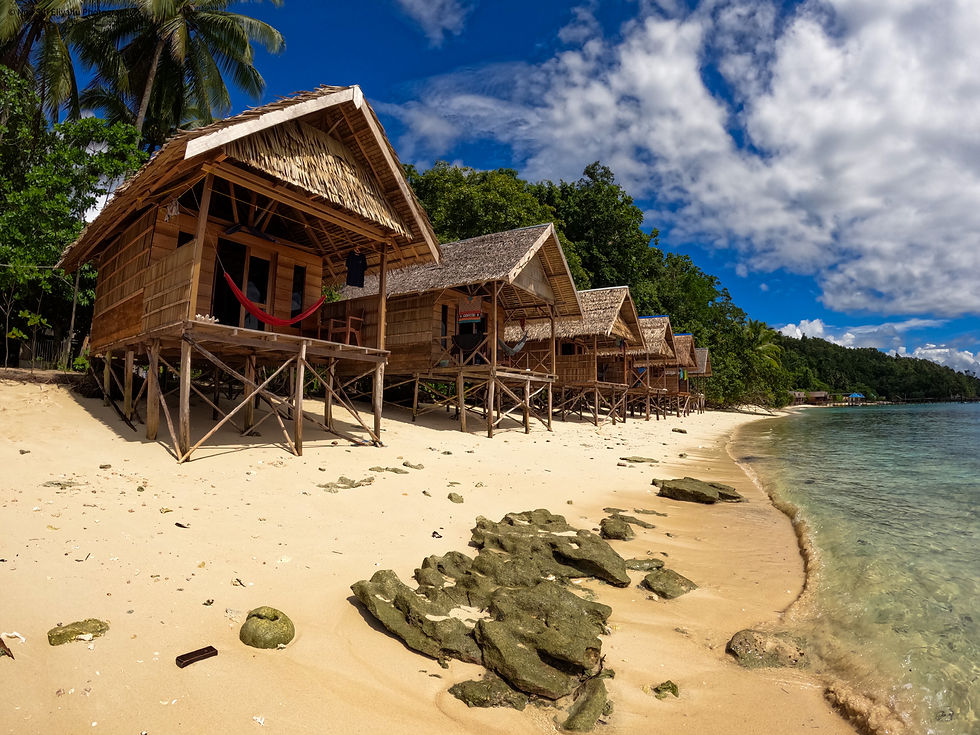
We arrived just before the divers returned from their morning dives, and once they did, we all sat down for lunch together. One thing I loved in Raja is that every homestay has its own personality. At Corepen, there’s one big table and everyone sits around it — so you don’t really have the option not to connect. Of course, you could take your plate and retreat to your balcony overlooking the endless sea (not a bad alternative), but most people seemed genuinely keen to chat, exchange dive stories, and get to know each other.
It felt like the perfect ending to the trip. The vibe reminded me a bit of Yenbuba — luxuriously simple. No unnecessary extras, just everything you actually need: a great room, a comfortable bed, a functioning fan (very important), a breathtaking balcony with hammocks, kind staff, delicious food, and most importantly… great dives.
When we arrived on Gam, I realized we would technically be diving in the “same” area as when we stayed on Kri, and I’ll admit, I felt a tiny bit bummed at first. But there were two things I hadn’t considered. First, we were diving with a small operation, which meant we, the clients, could literally decide where to go. Every evening after dinner, the divemaster would come by and ask which dive sites we were interested in. Everything felt possible. Second — and this is something Raja Ampat teaches you quickly — there is no such thing as “the same” dive here. Even at sites we had already visited, every dive showed us something different, something new, something unexpected. The dive center itself was everything you need. They had good equipment, they were organized, flexible and made sure you had a good time.
After a day underwater, you could relax in your hammock or explore the island. There’s a short 30-minute jungle walk that takes you up to another beautiful viewpoint on Gam. After a week, it was time to leave. And that moment when a trip ends is always a little painful. But if anything, we had given Raja Ampat the time it deserves. A month there would probably be ideal — just enough to fully fall in love, but still leave you wanting more.
Sorong
On the way back, we had to pass through Sorong. And after weeks of barefoot island life, we decided we couldn’t just throw ourselves back into chaos without a soft landing. So we booked one night at a Favehotel near the airport. It was close, affordable, and had everything we needed. We weren’t about to ruin our dreamy Raja bubble by staying somewhere depressing — so for 28 euros a night , we treated ourselves to a three-star hotel.
It also gave us the chance to properly say goodbye to the lovely couple we met on Kri Island — and dragged with us to do the exact same island route as us. There’s something about Raja Ampat that makes strangers stick together.
After what felt like an extensive fish-and-rice-only Raja Ampat diet, we were more than ready for something different. So naturally, we hunted down pizza. And not just any pizza — we found a Holland-owned place in Sorong called Pizzeria Terrazza di Sorong. Do yourself a favor and go there. It’s beautiful, the pizzas are genuinely good (even by Western standards), and their lime cake? Absolutely dangerous. The kind of dessert you think about days later.
And just like that, our Raja Ampat chapter came to a close — salty hair, full hearts, and slightly tighter wetsuits.
And just like that, our Raja Ampat adventure came to an end. A month of diving, crazy encounters both underwater and above, sunsets and rest. We were full in every sense — eyes, hearts, and stomachs. Every island had its own personality, every dive revealed something new, and every moment reminded us why we travel: to be surprised, amazed, and occasionally eaten alive by mosquitoes. Would I go back tomorrow if I could? In a heartbeat. Raja Ampat doesn’t just show you paradise — it makes you wish you never have to leave.

If you've read this far, you'll likely be pleased to hear that I'm organizing A dive/snorkel trip to Raja Ampat. Whether you're traveling alone, with family, or are ocean enthusiasts looking for a hassle-free experience, feel free to reach out to me.


Comments